
| ✅ CEC Accredited | ⚡ EV Charging Ready | 📍 Local Pakenham Team | 🚗 Solar + EV Specialists |
Table of Contents
| # | Section |
| 1 | EV Ownership in Pakenham Why This Question Is Becoming Urgent |
| 2 | How Solar Panels Power an Electric Vehicle |
| 3 | How Much Solar Power Does an EV Actually Use? |
| 4 | What Size Solar System Do You Need to Cover Your Car? |
| 5 | Solar + Battery + EV the Best Combination |
| 6 | EV Charger Types and Which Works Best with Solar |
| 7 | Real Savings: What Pakenham EV Owners Can Expect |
| 8 | Things That Affect Your Solar-to-EV Efficiency |
| 9 | EcoRun Energy Solar + EV Installations in Pakenham |
| 10 | FAQ |
Electric vehicles are arriving in Pakenham faster than most people expected. In three years, the proportion of new car registrations in Cardinia Shire that are EVs or plug-in hybrids has roughly tripled. The BYD Atto 3, the Tesla Model 3, the MG ZS EV, and the Kia EV6 are no longer rare sights on the streets of Lakeside or Officer. And almost every EV owner asks the same question once they’ve had the car for a month: what if I could just charge it from my roof?
The short answer is yes you can. The longer answer involves understanding how the numbers work, whether your current system is big enough, and what the combination of solar, battery, and EV actually looks like in a Pakenham household day-to-day. That’s what this guide covers.
1. EV Ownership in Pakenham Why This Question Is Becoming Urgent
The economics of EV ownership changed significantly when fuel prices spiked from 2022 onward. In Pakenham where a lot of households have longer commutes into Melbourne or to work sites across Cardinia the cost of filling a petrol tank every week became impossible to ignore.
The typical Pakenham household drives 40–80 km per day. At $1.90/litre and a fuel-efficient 6L/100km car, that’s $4.56–$9.12 per day in fuel. An EV covering the same distance uses roughly 8–16 kWh of electricity. At grid prices (30–35c/kWh), that’s $2.40–$5.60 per day. Charged from solar essentially free.
That’s the headline. The reality is slightly more nuanced, which is why this guide exists.
For EV ownership trends and environmental benefits in Victoria, the Better Health Channel has useful context on the state’s EV transition goals.
2. How Solar Panels Power an Electric Vehicle
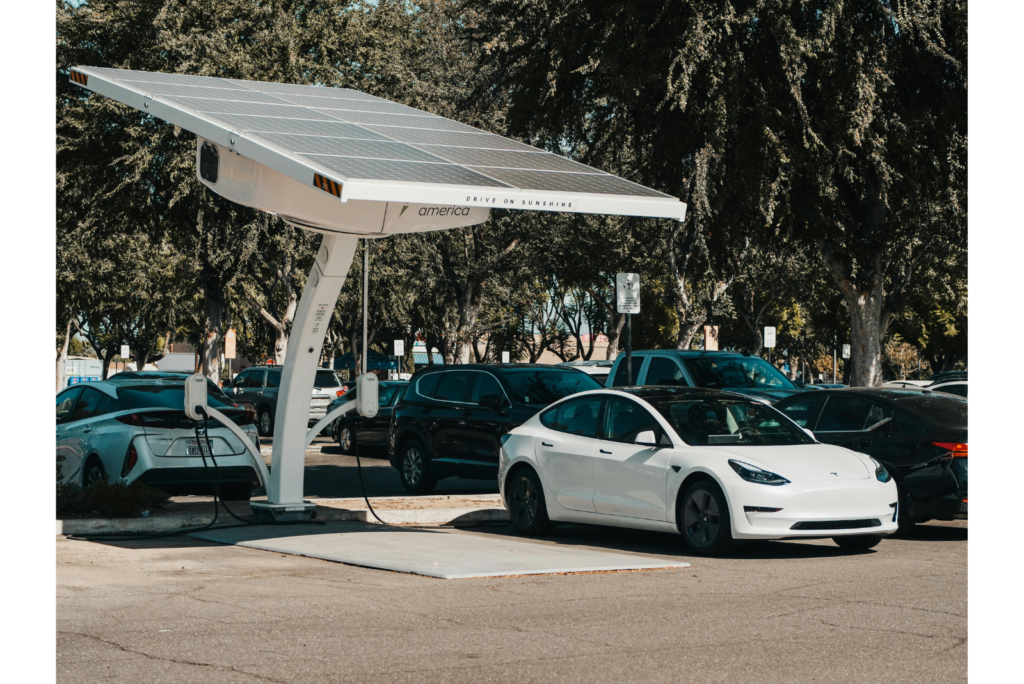
Solar panels don’t charge your car directly they feed electricity into your home’s AC circuit, and your EV charger then draws from that circuit. When your panels are generating more electricity than your home is using, the surplus is available for EV charging. If the charger draws more than the panels generate, the shortfall comes from the grid.
The key point: there’s no special connection or compatibility issue. Any EV that can charge from a standard AC circuit can be charged from solar, because solar electricity and grid electricity are the same on the AC side of your inverter.
What differs is how much of your charging is solar-sourced vs grid-sourced. This depends on when you charge, how big your system is, and whether you have battery storage.
The Clean Energy Council’s EV and Solar Guide covers compatibility and technical requirements in detail worth reading before making charger decisions.
Pakenham sun data: Pakenham receives an average of 4.3 peak sun hours daily. A 6.6kW system generates approximately 26–30 kWh per day in summer, 12–16 kWh in winter. An EV using 15 kWh per day for charging will consume a meaningful portion of that output which is why system sizing matters.
3. How Much Solar Power Does an EV Actually Use?
Most EVs consume 15–20 kWh per 100 km. The exact figure depends on the car, driving style, climate control use, and speed. In Pakenham conditions:
- BYD Atto : approximately 16–18 kWh/100km in mixed suburban/highway use
- Tesla Model 3: approximately 14–16 kWh/100km
- MG ZS EV: approximately 16–19 kWh/100km
- Kia EV6: approximately 15–18 kWh/100km
- Mitsubishi Outlander PHEV: approximately 20–25 kWh/100km (EV mode only)
For a 40km daily Pakenham commute, that’s roughly 6–8 kWh per day. A 6.6kW solar system generating 26 kWh can comfortably absorb that without any changes. For a 100km daily run tradies driving to Melbourne or outer suburbs you’re looking at 15–20 kWh per day, which starts to push the limits of a standard 6.6kW system if you also want to run the house.
4. What Size Solar System Do You Need to Cover Your Car?
The honest answer: it depends on how much you drive and what else is running in the house. Here’s a practical sizing guide for Pakenham households:
| System Size | Daily Generation (Pakenham avg) | EV km Covered | Best Suited For |
| 6.6kW (existing) | 26–30 kWh/day | ~120–160 km | Average commuter — 20–40km daily |
| 10kW | 38–44 kWh/day | ~170–220 km | Higher usage home + EV charging |
| 13.3kW | 50–58 kWh/day | ~230–290 km | Large home + EV + pool or AC |
| 6.6kW + 10kWh battery | 26–30 kWh + stored reserve | ~150–190 km | Standard commuter with evening charging preference |
| 10kW + 13.5kWh battery | 38–44 kWh + stored reserve | ~210–260 km | High-use home + EV + independence from grid |
If you already have a 6.6kW system and commute 20–40km daily, you probably don’t need to upgrade just for the EV your existing system should cover it with surplus to spare. If you’re doing 80–100km daily or running a ducted AC, pool pump, and EV simultaneously, a 10kW system starts making more sense.
For help sizing a new or upgraded system for your specific roof and usage, see EcoRun’s residential solar installation page or book a free assessment.
5. Solar + Battery + EV — the Best Combination
Here’s the scenario that makes the most financial sense for most Pakenham EV owners: a properly sized solar system combined with a battery, with the EV charging scheduled to maximise solar and battery use.
Without a battery, charging the EV from solar requires the car to be plugged in during daylight hours when you’re at work, this isn’t happening. Most people charge overnight, which means grid power rather than solar.
A battery changes this. The battery charges during the day from solar surplus. In the evening when you plug in, the car draws from the battery first not the grid. A 13.5 kWh Powerwall, for example, can cover both household evening usage and a reasonable overnight EV charge from stored solar.
For a full breakdown of battery economics in Pakenham including the Victorian Battery Rebate up to $2,950 see the should you add a battery blog for detailed numbers.
| Real Pakenham example: A household with a 10kW solar system, 13.5kWh battery, and a Tesla Model 3 averaging 50km/day found their quarterly electricity bill dropped from $420 to $38 a $1,528 annual saving while fuel costs dropped from $3,200/year to near zero. Total saving: over $4,700/year. |
EcoRun installs solar battery systems across Pakenham, Berwick, Officer, and the wider Cardinia area. See the solar battery storage page for current options.
6. EV Charger Types and Which Works Best with Solar
| Charger Type | Power Output | Charge Speed | Best Pairing | Approx Cost |
| Standard 10A plug (Mode 2) | 2.4kW | ~10–15 km/hour | Occasional users, small EVs | Included with car |
| 7kW AC Wall Charger (Mode 3) | 7kW | ~45–50 km/hour | Most Pakenham households | $800–$1,800 installed |
| 11kW AC Wall Charger | 11kW | ~65–75 km/hour | 3-phase supply homes | $1,200–$2,500 installed |
| 22kW AC Charger | 22kW | ~130–150 km/hour | 3-phase + high daily km | $2,000–$4,000 installed |
| DC Fast Charger | 50kW+ | 300–500 km/hour | Commercial — not residential | $15,000+ |
For most Pakenham households, a 7kW AC wall charger is the right choice. It charges fast enough that a full overnight charge (starting at 20% battery) takes 6–8 hours, and it draws at a rate manageable for a standard single-phase solar system. Some smart chargers can be programmed to only draw when solar is generating useful for households who are home during the day.
If you’re on 3-phase supply increasingly common in newer Lakeside and Arena estates an 11kW charger is worth considering. Faster charge times and better matched to larger EV batteries.
7. Real Savings: What Pakenham EV Owners Can Expect
These figures assume a 10kW solar system with battery, replacing a petrol car with an EV, using solar as the primary charge source. Petrol costs calculated at $1.90/litre, 7L/100km average.
| Scenario | Annual Fuel Cost (Petrol) | Annual EV Cost (Grid) | Annual EV Cost (Solar) | Saving vs Petrol |
| 20km daily commute | ~$2,100 | ~$520 | ~$80–$150 | $1,950–$2,020 per year |
| 40km daily commute | ~$4,200 | ~$1,040 | ~$160–$280 | $3,920–$4,040 per year |
| 80km daily commute | ~$8,400 | ~$2,080 | ~$320–$560 | $7,840–$8,080 per year |
| 100km daily (tradie/sales) | ~$10,500 | ~$2,600 | ~$400–$700 | $9,800–$10,100 per year |
Even without a battery charging purely from the grid at off-peak rates the EV savings over petrol are significant. Adding solar and charging from your roof rather than the grid amplifies those savings considerably.
To compare electricity tariffs and find the best EV charging rate in Victoria, use the free Victorian Energy tool some retailers offer dedicated EV overnight rates below 15c/kWh.
8. Things That Affect Your Solar-to-EV Efficiency
A few variables that are worth understanding before you get too attached to the ideal scenario:
- Charging timing: if you charge overnight from grid power, your solar is irrelevant to EV costs without a battery. Midday charging or battery storage is the solution
- System export limits: some Pakenham properties on the Ausnet network have 5kW export caps. This doesn’t affect self-consumption, but it means surplus above that cap is wasted if you’re not home to use it (or store it in a battery)
- EV charger smart scheduling: some chargers (Zappi, Tesla Wall Connector, JuiceBox) can be set to charge only when solar is generating above a threshold. Worth specifying when purchasing
- Seasonal variation: winter generation in Pakenham drops to 12–16 kWh/day. If your EV needs 15 kWh daily, winter coverage from solar alone may be partial
- Round-trip efficiency: batteries have 90–95% round-trip efficiency, meaning a small percentage of stored energy is lost. Factor this into calculations
9. EcoRun Energy — Solar + EV Installations in Pakenham
EcoRun Energy — Solar Panel Installers Pakenham
If you're looking for the best accredited solar panel installers in Pakenham, the simplest filter is this: check who's been doing it locally, consistently, for years  not who has the loudest ads. EcoRun Energy has been installing solar across Pakenham and the Cardinia corridor since 2016. CEC accredited, Energy Safe Victoria approved, in-house team only no subcontractors.
Over 5,000 installations across Pakenham and the Cardinia corridor. We design systems specifically for EV charging needs  factoring in your daily km, charge timing preferences, and whether battery storage makes financial sense for your household.
Call 1300 315 484  |  ecorunenergysolar.com.au  |  29 Hill St, Pakenham VIC 3810
EcoRun also covers nearby suburbs including Officer, Berwick and Narre Warren. Book a free EV solar assessment to get numbers specific to your home.
FAQ — Local vs National Solar Installers in Pakenham
Yes, in principle — but ‘entirely’ depends on your daily km, system size, and charging timing. A 6.6kW system generates enough to cover a 40–60km daily commute with surplus for the house. For 100km+ daily driving, a 10kW system is more appropriate. Without a battery, charging during daylight hours is needed to maximise solar use. With a battery, overnight charging from stored solar is possible.
No special inverter is needed. Your EV charger connects to the AC circuit of your home like any other appliance, and draws from whatever source (solar, battery, or grid) is available. Some smart chargers can be configured to prioritise solar — that’s where setup choices matter, but it’s not a hardware compatibility issue.
It depends on your system size and charging timing. If your existing system comfortably covers your household usage and has surplus, adding EV charging (particularly during the day or with a battery at night) may add very little or nothing to your bill. If your system is already sized tightly, you may see some grid import increase — which is the trigger to consider a system expansion.
Midday — when solar generation peaks. Set your charger to run between 10am and 2pm if you can. This maximises the amount of charging that comes from solar rather than the grid. If you’re not home during the day, a battery paired with an overnight charge schedule is the next best option.
A 10kW solar system in Pakenham costs approximately $8,000–$12,000 after STCs and Solar Victoria rebates. A 7kW AC wall charger adds $800–$1,800 installed. A 10kWh battery adds $9,000–$14,000 (reduced by up to $2,950 with the Victorian Battery Rebate). Total for a full solar + battery + EV charger setup: $18,000–$27,000 depending on specifications — with a typical payback of 5–8 years when replacing both petrol and grid electricity costs.