
Table of Contents
- Introduction A Question Worth Answering Properly
- How Rooftop Solar Works (And What It Actually Costs in 2026)
- How Battery-Only Storage Works (And Who It’s Actually For)
- Solar + Battery Combined: When It’s Worth Doing Together
- The Real Numbers: Payback Comparison Across Three Scenarios
- Battery Options Available in Pakenham in 2026
- The Cheaper Home Batteries Federal Rebate What It Means Right Now
- Frequently Asked Questions
- Conclusion Which One Should You Actually Get?
1. Introduction — A Question Worth Answering Properly
Most solar conversations start with ‘should I add a battery?’ and quickly become confusing because batteries and solar panels do fundamentally different things. They’re often sold together, but they don’t have to be and in some situations, getting one without the other is the right financial decision.
Here’s the clearest way to think about it:
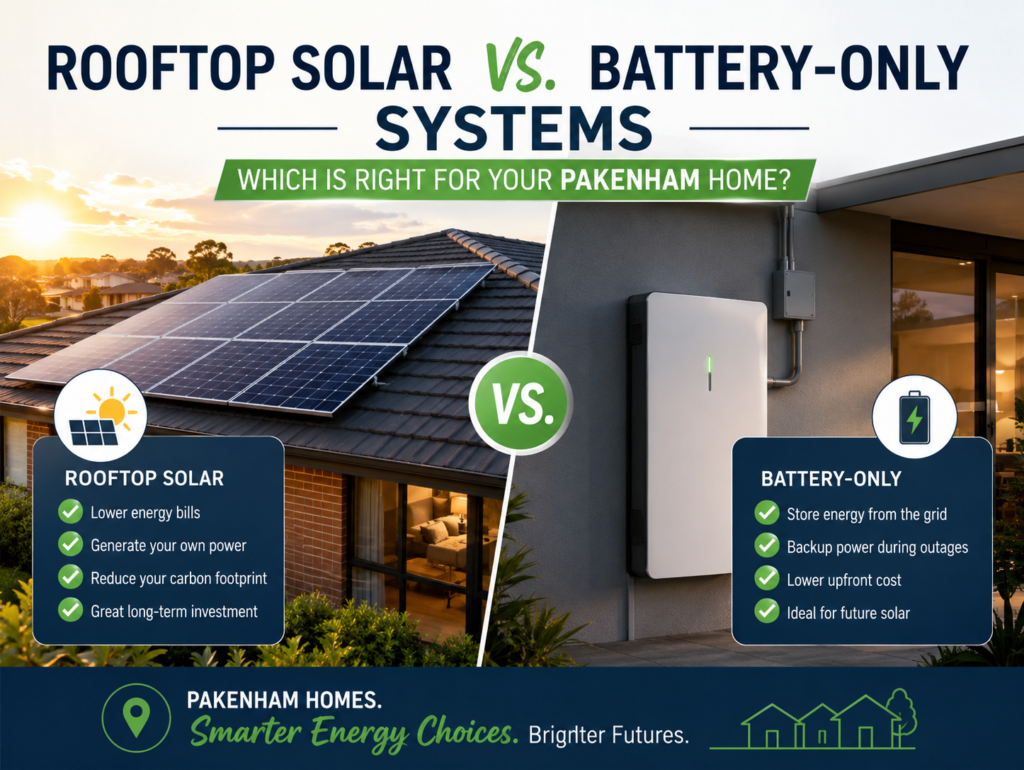
Solar vs. Battery: The Core Distinction • Rooftop solar generates electricity from sunlight during the day. It reduces what you buy from the grid in real time. • A battery stores electricity either from your solar panels or from the grid for use later, typically in the evening. • Solar saves by reducing grid purchases during production hours. • Battery saves by shifting when you consume either your solar surplus or cheap off-peak grid power. • One generates. One stores. They solve different problems.
For most Pakenham homeowners, the financial case for solar is clear and fast-payback. The case for battery storage is more conditional it depends on your evening usage, your tariff structure, and what you’re trying to achieve.
This post walks through both options with real 2026 pricing and payback figures, so you can make a decision based on your household’s actual situation.
2. How Rooftop Solar Works (And What It Actually Costs in 2026)
A rooftop solar system converts sunlight into electricity during daylight hours. Whatever your household uses at that moment comes from the panels free of charge. Anything you don’t use either gets exported to the grid (earning a feed-in tariff) or, if you have a battery, stored for later.
In 2026, the typical installed cost of a 6.6kW residential system in Pakenham after the Solar Victoria rebate of up to $1,400 and federal STC rebate is approximately $3,800–$6,500. A 10kW system runs $5,500–$8,500 net of rebates.
| System Size | Gross Cost (Approx.) | Net After Rebates | Annual Saving (Est.) | Payback Period |
| 5kW | $5,500–$7,500 | $3,800–$5,500 | $1,100–$1,500 | 3–4 years |
| 6.6kW | $6,500–$9,000 | $4,500–$6,800 | $1,500–$2,100 | 3–4.5 years |
| 10kW | $8,500–$11,500 | $6,200–$9,000 | $2,000–$2,800 | 3–4 years |
| 13.2kW | $11,000–$15,000 | $8,500–$12,000 | $2,500–$3,500 | 3.5–4.5 years |
Solar payback is driven mainly by self-consumption. A Pakenham household that’s home during the day and runs appliances when the panels are producing will see faster payback than one where nobody is home until 6pm. For a detailed breakdown of how location and usage patterns affect your savings, our Pakenham vs Melbourne CBD solar savings comparison has the numbers.
3. How Battery-Only Storage Works (And Who It’s Actually For)
A battery-only setup — adding storage without solar panels — is less common but a legitimate option for some households.
In this scenario, the battery charges from the grid during cheap off-peak hours (typically 11pm–6am on time-of-use tariffs) and discharges during expensive peak periods (typically 3pm–9pm). You’re arbitraging the difference between cheap off-peak power and expensive peak-rate power.
| Metric | Battery-Only Setup |
| Charge source | Grid (off-peak hours) |
| Off-peak grid rate (typical, Victoria) | 15–22c/kWh |
| Peak grid rate avoided | 38–52c/kWh (time-of-use peak) |
| Daily saving per kWh cycled | ~16–30c/kWh |
| Typical battery capacity (13.5kWh) | ~$2.16–$4.05/day saving (if fully cycled) |
| Annual saving estimate | $790–$1,480/year |
| Battery cost installed (13.5kWh) | $13,500–$16,000 |
| Payback period (battery only) | 9–17 years |
Battery-only payback of 9–17 years is long relative to solar. The economics are weaker because you’re still paying for the electricity — just at a cheaper time. Solar panels generate electricity at zero fuel cost. Batteries just repackage it.
Battery-only makes the most sense for: households on time-of-use tariffs with a very large peak-to-off-peak price differential, households in apartments who can’t install solar, or households where backup power during outages is the primary motivation (not bill reduction).
4. Solar + Battery Combined: When It’s Worth Doing Together
The strongest case for home battery storage is when it’s combined with solar panels. Here, the battery charges from surplus solar during the day power that would otherwise be exported at 3–8c/kWh and discharges in the evening when the panels aren’t producing.
Every kWh that goes through this cycle saves you the retail rate you’d otherwise pay in the evening (28–35c) instead of earning a low feed-in tariff (3–8c). That’s 20–30c of additional value per kWh cycled through the battery, compared to exporting it.
| Scenario | Without Battery | With Battery Added |
| Solar surplus at midday | Exported at 3–8c/kWh | Stored for evening use |
| Evening electricity | Bought from grid at 28–35c/kWh | Drawn from battery (solar stored) |
| Value per kWh of surplus | 3–8c earned | 28–35c saved |
| Self-consumption rate | 30–50% of generation | 60–80% of generation |
| Backup during blackout | No | Yes (with gateway/backup unit) |
The financial case for adding a battery to an existing solar system is strongest when: your household uses significant electricity in the evenings (after 4pm), your current feed-in tariff is low (3–5c/kWh), and you have a solar system that regularly produces surplus during the day.
For Pakenham households with existing solar who want to understand whether a battery makes sense, the first step is checking your current production and consumption data in your inverter app. If you’re consistently exporting large amounts during the day and buying back from the grid at night, battery storage is likely cost-effective. Contact us to discuss your specific situation.
5. The Real Numbers: Payback Comparison Across Three Scenarios
Let’s put all three options side by side for a typical 4-bedroom Pakenham home with moderate-to-high energy use (22–30 kWh/day).
| Option | Net Upfront Cost | Annual Saving | Payback Period | 20-Year Net Benefit |
| Solar only (6.6kW) | ~$5,200 | ~$1,800 | ~3 years | ~$31,000 |
| Battery only (13.5kWh) | ~$13,500 | ~$1,100 | ~12 years | ~$8,500 |
| Solar + Battery (6.6kW + 13.5kWh) | ~$19,000 | ~$2,700 | ~7 years | ~$35,000 |
Solar-only has the fastest payback by a wide margin. Battery-only has the slowest. Solar + battery has a longer payback than solar alone, but the 20-year net benefit is highest because you’re saving at the full grid rate on a greater proportion of your consumption.
For most Pakenham homeowners choosing between options for the first time, solar-only is the highest-return first step. Adding a battery later once you understand your actual solar production and usage patterns — is often smarter than committing to both upfront without data.
6. Battery Options Available in Pakenham in 2026
Three batteries dominate the Australian home storage market in 2026. Here’s an honest comparison based on current pricing and performance data.
| Battery | Usable Capacity | Supply Price (Approx.) | Cost/kWh | Key Advantage | Consider If… |
| Tesla Powerwall 3 | 13.5 kWh | ~$9,000–$11,900 | ~$860/kWh | Built-in inverter, simplest install, excellent VPP support | New solar + battery install from scratch |
| BYD Battery-Box HVM 16.6 | 16.6 kWh | ~$8,500 | ~$512/kWh | Best value per kWh, modular, wide inverter compatibility | You have a compatible existing inverter |
| Sungrow SBR160 | 16 kWh | ~$10,500 | ~$656/kWh | 97% efficiency, scalable to 25.6kWh, strong Sungrow ecosystem | You have or plan a Sungrow hybrid inverter |
Installation adds approximately $1,500–$3,000 depending on switchboard condition and site complexity. The federal Cheaper Home Batteries rebate reduces costs by roughly $300 per usable kWh — on a 13.5kWh system that’s approximately $4,050 off. The rebate structure changes in mid-2026 when tiered rates apply; locking in current pricing is worth considering.
For a breakdown of how these batteries compare in terms of performance, warranty, and compatibility with your existing setup, contact our Pakenham team and we can advise based on your inverter model and home setup.
7. The Cheaper Home Batteries Federal Rebate — What It Means Right Now
The Australian Government’s Cheaper Home Batteries Program launched 1 July 2025. It provides an upfront rebate of approximately $300 per usable kWh of battery storage, applied at the point of sale via your installer — similar to how STC rebates work for solar.
Cheaper Home Batteries Program — Key Details (2026) • Rebate amount: ~$300/kWh of usable storage (tiered rates apply from mid-2026) • On a 13.5kWh battery: approximately $4,050 off the installed price • On a 16kWh battery: approximately $4,800 off the installed price • Applied at invoice — no claiming process required by the homeowner • Available for new battery installations and battery additions to existing solar systems • Must be installed by an accredited installer — CEC accreditation applies • Can stack with state-level programs where available (Victorian battery loan scheme has closed)
Combined with the solar STC rebate and Solar Victoria residential rebate ($1,400), a household installing solar and battery together in 2026 can reduce the combined gross cost by $8,000–$12,000 depending on system sizes.
One timing note: the rebate structure changes in mid-2026 when tiered rates take effect. Installing before that change locks in the current flat-rate discount. If you’re considering solar + battery, sooner is better than later. Get in touch to check current availability.
8. Frequently Asked Questions
Q1. Is it better to install solar first and add a battery later?
For most Pakenham households, yes. Solar gives you the fastest and clearest payback first. After 12–18 months of operation, you have real data on how much your system produces, how much you self-consume, and how much you export. That data tells you whether a battery would actually improve the economics — or whether your household usage pattern means the extra investment wouldn’t pay back in a reasonable timeframe. Installing both at once makes sense mainly if you’re building new, doing a major renovation, or have a strong motivation beyond bill savings (like backup power).
Q2. Can I add a battery to my existing solar system?
Usually yes — but compatibility matters. If your existing inverter is a hybrid model (designed for battery integration), adding a battery is straightforward. If you have a standard string inverter, you’ll need either an AC-coupled battery (like the Powerwall 3, which includes its own inverter) or to replace the inverter with a hybrid model. We can assess compatibility from your inverter model — contact us with the brand and model of your current inverter and we’ll advise.
Q3. How much can a home battery actually save in Pakenham?
For a household with solar that currently exports significant surplus during the day and buys back from the grid in the evening, a 13.5kWh battery can realistically save an additional $800–$1,400 per year on top of solar savings. For a battery-only household on a time-of-use tariff, savings of $900–$1,400 per year are possible through peak/off-peak arbitrage. These are realistic estimates — actual savings depend heavily on your specific usage profile and tariff.
Q4. Does a battery provide backup power during a blackout?
Not automatically on all battery systems. Most batteries require a specific backup gateway or automatic transfer switch to isolate your home from the grid during an outage and allow the battery to supply power. The Tesla Powerwall 3 with Backup Gateway has this built in. BYD and Sungrow systems require an additional component. If backup is a priority — perhaps because your home office depends on power, or you have medical equipment confirm backup capability explicitly with your installer before choosing a battery model.
Q5. What is the Cheaper Home Batteries rebate and how do I access it?
The federal Cheaper Home Batteries Program provides approximately $300 per usable kWh of battery storage off your installed cost roughly $4,050 off a 13.5kWh battery. It’s applied automatically at the invoice stage by your installer (similar to how STC rebates work for solar). You don’t need to apply separately. The program launched 1 July 2025 and the rebate structure changes in mid-2026 when tiered rates apply, so installing under the current flat rate while it lasts is worth considering. Ask your installer to confirm the current rebate amount at the time of quoting.
Q6. Can I go completely off-grid with solar and battery in Pakenham?
Technically possible, but not financially recommended for most Pakenham suburban homes. True off-grid requires significant battery capacity to cover several days of cloudy weather in winter often 30–60kWh or more plus backup generation. The cost far exceeds what a grid-connected solar-plus-battery system would cost, and the payback period extends to 15+ years. For suburban homes with access to the grid, staying grid-connected with a battery for evening use and backup makes much better financial sense.
Q7. Should I get solar, battery, or both in 2026 if I’m starting from scratch?
If budget isn’t a constraint: solar + battery together, sized to your actual usage, with a hybrid inverter. Install once, benefit from both from day one, and maximise the current federal rebates before mid-2026 changes. If budget is a constraint: solar first. It has the fastest payback and the clearest return. Add battery when you have 12–18 months of production data and a clearer picture of your evening usage patterns. Either way, our team can model both options against your actual electricity bills so you’re deciding with real numbers, not estimates.
9. Conclusion -Which One Should You Actually Get?
If you have to pick one: solar panels. They have the fastest payback, the clearest financial return, and the most straightforward installation. For most Pakenham households, a well-sized solar system pays back in 3–4 years and saves $1,500–$2,500 per year for the following 20+ years.
Battery storage is compelling as a second step once you understand how your solar system actually produces and you can see whether evening usage and low feed-in tariffs make the addition worthwhile. It’s not a universal answer, and anyone pushing it as an automatic upgrade without modelling your specific situation first isn’t giving you an honest assessment.
Solar + battery together makes the most financial sense when: you’re doing a fresh install, you have high evening consumption, you want blackout backup, or the federal battery rebate makes the combined cost attractive enough that the combined payback still comes in under 8 years.
EcoRun Energy installs solar, battery storage, and solar + battery combinations across Pakenham, Berwick, Narre Warren, Officer, and the wider Cardinia Shire. We’ll model your specific household against real costs and current incentives no guesswork, no overselling. Get your free assessment here.