
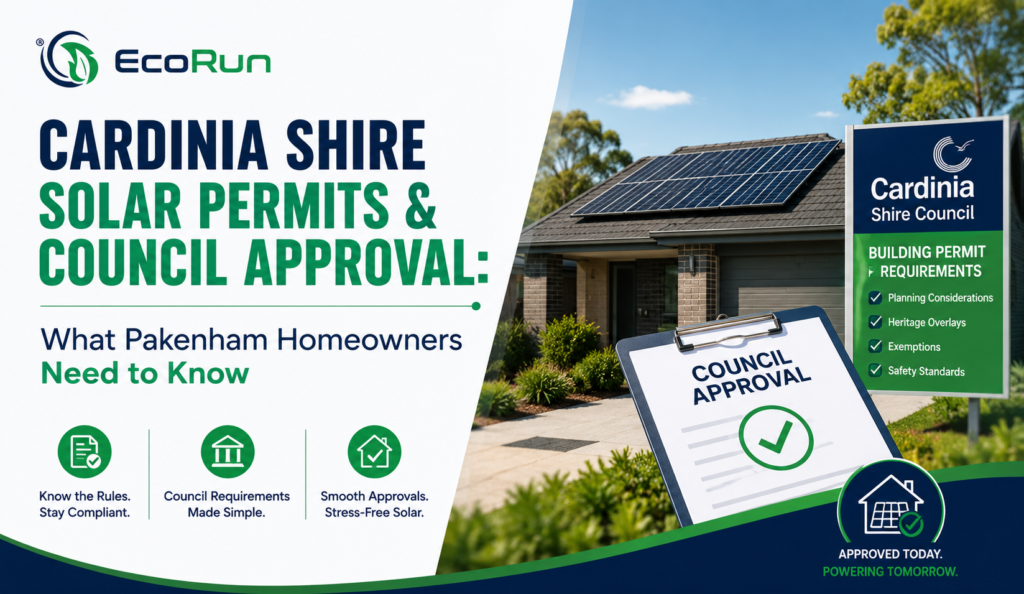
One of the most common questions we hear from Pakenham homeowners is whether they need council approval before installing solar. The good news: most standard residential rooftop installations don’t require a planning permit at all. But there are specific situations heritage overlays, properties near declared roads, apartments, and ground-mounted systems where approval genuinely is required, and getting this wrong can delay your installation by weeks. Here’s exactly where the line sits.
The Short Answer: Most Homes Don’t Need a Planning Permit
For a typical single-storey or double-storey home with a standard tile or Colorbond roof, installing rooftop solar is generally considered exempt from planning permit requirements under Victorian regulations. Instead, the installation is governed by electrical safety and grid-connection rules rather than council planning — meaning your CEC-accredited installer’s compliance certificate and your energy retailer’s grid-connection approval are the paperwork that actually matters for most homes.
When Cardinia Shire Council Approval IS Required
You’ll need to check with Cardinia Shire Council directly, or have your installer do so, if any of the following apply to your property:
- Heritage overlay properties — some older parts of Pakenham and surrounding townships fall under a Heritage Overlay, which can restrict visible alterations to roof lines, including solar arrays visible from the street
- Properties near a declared road or within a Road Zone overlay — relevant for some Pakenham properties fronting arterial roads
- Significant Landscape or Vegetation Protection overlays — if your property has tree protection controls that could be affected by scaffolding or access requirements
- Ground-mounted solar systems — rather than roof-mounted, these are treated differently under planning rules and are more likely to require a permit
- Strata title properties — apartments, units, and townhouses often require body corporate or owners’ corporation approval in addition to (or instead of) council approval
- Commercial and industrial properties — larger commercial installations can trigger different planning triggers than standard residential exemptions
If none of these apply — which is the case for the large majority of standard Pakenham homes — you can generally proceed straight to installation without a separate planning permit application.
What Approval Actually Involves for the Exceptions Above
Where a permit or approval is required, the process typically involves:
- Lodging a planning permit application with Cardinia Shire Council, including roof plans and panel layout
- For heritage-overlay properties, a heritage impact assessment addressing visibility from the street or public realm
- For strata properties, written consent from the owners’ corporation, sometimes requiring a vote at a general meeting
- Council assessment period, which can range from a few weeks to two months depending on complexity and whether notice to neighbours is required
The Paperwork That Applies to Every Installation (Permit or Not)
Regardless of whether council approval applies to your property, every solar installation in Victoria requires:
- A Certificate of Electrical Safety (COES) issued by your installer upon completion
- Grid connection approval from your local distribution network (AusNet Services covers the Pakenham area)
- Notification to your energy retailer to enable feed-in tariff payments
- Correct STC and Solar Victoria rebate paperwork if you’re claiming those incentives
This is the paperwork that catches people out when using inexperienced or non-accredited installers — missing or incorrect documentation here can delay activation even when no planning permit was ever required.
Typical Timeframes
For a standard exempt residential solar panel installation, the timeline from signed quote to system activation is usually four to eight weeks, covering design, equipment ordering, installation, and grid-connection approval. If your property requires council planning approval due to heritage overlay or similar factors, add several additional weeks for the planning assessment before installation can begin.
How EcoRun Energy Handles This for You
As part of every Pakenham consultation, we check your specific property against Cardinia Shire’s overlay maps before finalising your design not after. If your property does require council approval, we prepare and lodge the application on your behalf and keep you updated on council’s timeline. If you’re in a strata property, we provide the technical documentation your owners’ corporation will need to approve the request.
Frequently Asked Questions
Most standard residential rooftop installations are exempt from planning permits. Approval is typically only required for heritage overlay properties, some road-zone properties, ground-mounted systems, and strata/apartment buildings.
You can check Cardinia Shire Council’s planning scheme maps directly, or ask your installer to check on your behalf as part of your initial consultation — this should happen before your system is designed, not after.
In most strata and owners’ corporation properties, yes — written consent is required, and larger developments may need a vote at a general meeting. Your installer can provide the technical documentation needed for that approval.
Timeframes vary, but heritage or planning-related approvals can add several weeks to a couple of months on top of the standard 4–8 week installation timeline, depending on complexity and whether neighbour notification is required.