Every spring and summer, south-east Melbourne gets a reminder that Australian weather doesn’t play nice. Pakenham and the wider Cardinia Shire corridor has seen its share of hailstorms the kind that dent car bonnets, crack windscreens, and send homeowners scrambling to check their rooftops.
If you’re considering solar panels or you’ve just had them installed one question probably keeps coming back: what actually happens if a serious hailstorm hits?
This guide gives you a straight answer based on real engineering standards, not marketing spin. We cover the international test standards every quality solar panel must pass, what Victorian weather data actually shows, the honest difference between a workmanship warranty and a product warranty, and what you should do the moment hail is forecast.
By the end, you’ll know exactly why the right panel choice and the right installer matters far more than the hail itself.
| Table of Contents |
| 1. How bad are hailstorms in Pakenham, really? |
| 2. The IEC 61215 standard: what solar panels must survive |
| 3. Real-world hail test dat what 35mm actually means |
| 4. Does my solar warranty cover hail damage? |
| 5. The Tier 1 difference: why panel brand matters in a storm |
| 6. What your installer does (or should do) to protect your system |
| 7. What to do before, during, and after a hailstorm |
| 8. Solar vs. the rest of your roof: putting risk in perspective |
| 9. FAQ |
| 10. The bottom line |
1. How Bad Are Hailstorms in Pakenham, Really?
Let’s start with the honest answer: Pakenham does get hail, and occasionally it gets serious hail. Sitting at the foot of the Dandenong Ranges, the Cardinia Shire corridor is part of south-east Melbourne’s thunderstorm belt a region that experiences convective storms rolling in from the north and west during the October–March season.
The Bureau of Meteorology records significant hail events across this corridor most years. Most are in the 10–20mm range enough to bruise fruit and damage soft vegetation. Events above 35mm are rarer but do occur. The 2010 Melbourne hailstorm produced hailstones above 70mm in some eastern suburbs. The March 2022 event caused widespread insurance claims across Casey and Cardinia.
So hail is real. The question is not whether Pakenham gets hail it does. The question is whether modern solar panels are engineered to survive it. The answer, for quality panels, is an unambiguous yes and here’s why.
2. The IEC 61215 Standard: What Solar Panels Must Survive
Every solar panel sold in Australia through CEC-approved channels must comply with the IEC 61215 international standard the global benchmark for photovoltaic module performance and safety. One component of this standard is a mandatory hail impact test.
What the IEC hail test requires:
- Hailstone size: 25mm diameter (solid ice sphere)
- Impact velocity: 23 m/s (approximately 83 km/h)
- Impact points: 11 defined strike locations across the panel surface
- Pass condition: No cracking, no delamination, no significant performance loss after all 11 strikes
This is the minimum requirement. Many Tier 1 manufacturers test beyond this specification. Jinko Solar and Longi two of the four brands EcoRun Energy installs regularly test their panels at 35mm hailstones at 97 km/h, well above the IEC minimum. Canadian Solar and Risen Energy panels are also routinely tested at this enhanced specification.
To put 35mm in context: the Bureau of Meteorology defines large hail as any stone 20mm or greater. A 35mm stone is at the upper end of what a typical Victorian storm produces. Hail events above 40mm in the Pakenham area are rare — and the panels EcoRun installs are designed to withstand exactly this range.
3. Real-World Hail Test Data: What 35mm Actually Means
Numbers are one thing. Let’s translate this into something concrete for Pakenham homeowners.
| Hailstone Size | Typical Impact Speed | IEC 61215 Coverage? | Tier 1 Extended Test? | Risk to Quality Panels |
| Under 20mm | < 60 km/h | Yes | Yes | Negligible |
| 20–25mm | 60–75 km/h | Yes | Yes | Very low |
| 25–35mm | 75–97 km/h | Minimum threshold | Yes | Low |
| 35–50mm | 97–115 km/h | Below spec | Partially | Moderate — inspect post-storm |
| 50mm+ | 115+ km/h | Below spec | No | Higher risk — rare in Pakenham |
In most Pakenham hailstorms, the hailstones fall in the 10–30mm range. Quality Tier 1 panels handle this comfortably. Even in larger events the 40–50mm range that might affect your car panels survive the vast majority of impacts without damage.
The temperate glass used in modern solar panels is specifically engineered for impact resistance. It is typically 3.2mm thick, low-iron toughened glass significantly harder than a standard window. The tempered treatment means it is designed to flex slightly on impact rather than shatter, absorbing energy the way a windscreen is designed to crumple in a collision rather than break apart.
Important: What Testing Cannot Guarantee
No test standard covers every possible storm scenario. In a catastrophic hail event  grapefruit-sized stones at high velocity  any roof surface can be damaged. What testing guarantees is that your panels will not be the weakest point on your roof. Your roof tiles, gutters, skylights, and windows are all more vulnerable to hail than a properly installed quality solar panel.
4. Does My Solar Warranty Cover Hail Damage?
This is where homeowners often get caught out. Understanding the difference between your panel warranty and your home insurance is critical and the two work in very different ways.
The three warranty types that matter:
A. Manufacturer’s Product Warranty (10–15 years)
Covers manufacturing defects delamination, junction box failure, frame corrosion, micro-cracks caused by faulty production. Most Tier 1 manufacturers offer a 12–15 year product warranty. This does NOT cover physical impact damage from hail or storm events.
B. Performance (Linear) Warranty (25 years)
This is the warranty that matters most long-term. Quality panels guarantee a minimum power output typically 97–98% in year one, degrading no more than 0.5% per year, with a floor of 80–82% at year 25. If a hailstorm causes micro-damage that gradually reduces output below this guaranteed threshold, you have a warranty claim. But visible cracking from a direct impact is typically treated as physical damage, not a performance warranty event.
C. Installer’s Workmanship Warranty (5–10 years)
EcoRun Energy provides a 10-year workmanship warranty on all installations. This covers anything related to how the system was installed mounting, wiring, waterproofing, and structural integrity. If hail causes a bracket to loosen or water to penetrate because of how the system was mounted, this is covered. Hail that directly cracks a panel is physical damage outside the workmanship scope.
The answer: home insurance is your hail protection
Most Australian home and contents policies include storm and hail damage as a standard event. Solar panels are treated as a fixed part of the structure they’re covered the same way your roof tiles are covered. Before installation, call your insurer to confirm:
- Solar panels are explicitly included in your building cover
- The declared value of your home is updated to include the system value
- You have the installation certificate and product specifications to provide in the event of a claim
EcoRun Tip: Documentation Before the Storm:
After installation, photograph your panels and store the photos in cloud storage. Document the panel brand, model numbers, and installation date. If you ever need to make a claim, having clear pre-storm documentation significantly speeds up the process and prevents disputes about whether damage existed before the event.
5. The Tier 1 Difference: Why Panel Brand Matters in a Storm
Not all solar panels are created equal. This matters a great deal when hail enters the picture.
Tier 1 classification as assessed by Bloomberg NEF is based on a manufacturer’s financial stability, production scale, and quality control processes. It does not directly rate hail resistance, but it strongly correlates with it for one key reason: manufacturers who invest in quality glass, robust encapsulants, and rigorous QA testing produce panels that also perform better in physical stress scenarios like hail.
What EcoRun Energy installs and why:
| Panel Brand | Type | Certified Hail Rating | Warranty (Product) | Notes for Victorian Climate |
| Jinko Solar | Tiger Neo (N-type TOPCon) | 35mm @ 97 km/h | 12 years | Outstanding low-light performance |
| Longi Solar | Hi-MO 6 / Hi-MO X6 | 35mm @ 97 km/h | 12 years | Lowest degradation rate in class |
| Canadian Solar | HiKu / BiKu series | 25mm minimum, many at 35mm | 12 years | Strong VIC market presence |
| Risen Energy | Titan / Neon series | 35mm (product-line dependent) | 12 years | Excellent value, robust frame |
All four brands EcoRun installs are CEC-approved products listed on the Clean Energy Council’s approved product register. This is a non-negotiable requirement for accessing Victorian Solar Homes rebates. If a company quotes you on a panel brand not on the CEC list, walk away you’ll lose your rebate and your protection.
Learn more about our product range on our residential solar installation page.
6. What Your Installer Does (or Should Do) to Protect Your System
The panel itself is only part of the hail story. How the system is installed determines whether rain, wind, and impact forces behave predictably or create vulnerabilities.
Mounting and racking
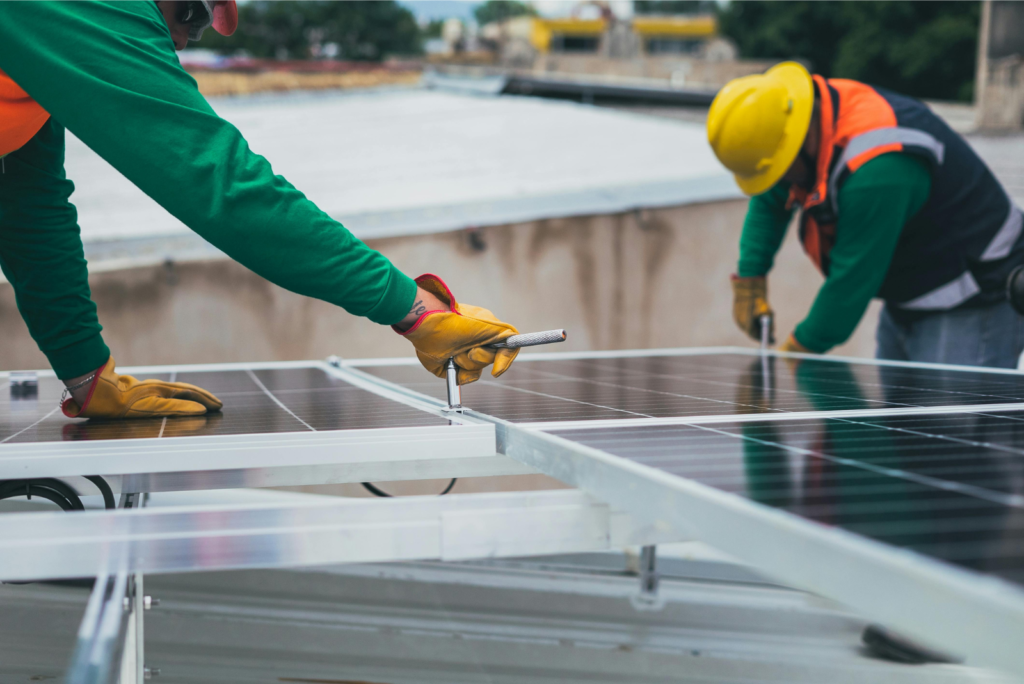
EcoRun uses commercial-grade aluminium racking systems rated for wind speeds well above any recorded Pakenham event. Roof penetrations are sealed with weatherproof flashings appropriate for tile or Colorbond roofing. A loose or incorrectly mounted panel is more vulnerable to hail damage not because of the panel, but because vibration and movement concentrate stress at the glass edges, exactly where cracking initiates.
Cable management
Exposed DC cabling is a hail vulnerability that homeowners rarely consider. Properly managed cables — secured flat against the roof surface and protected by conduit where exposed — are not affected by hail. Cables left hanging in loops or draped over the frame are at risk of damage from large hailstones.
Inverter placement
Inverters should always be installed under shelter — in a garage, under eaves, or in a dedicated enclosure. A wall-mounted inverter exposed to direct hail impact is a genuine risk. EcoRun never installs inverters in exposed outdoor locations without appropriate protection.
Roof type considerations
Pakenham’s housing stock is predominantly tiled roofs (terracotta and concrete) and Colorbond/metal roofs. Both handle solar mounting well, but the waterproofing approach differs. Tile roofs require tile hooks and careful flashing. Metal roofs use clamp-based systems that avoid penetrations entirely. Ask your installer specifically how they protect each penetration point on your roof type.
7. What to Do Before, During, and After a Hailstorm
Before a storm (when a warning is issued):
- Check the Bureau of Meteorology for severe thunderstorm warnings for Cardinia Shire.
- Do not climb onto your roof. There is nothing you can do to protect installed panels — and the risk to you is far greater than the risk to the panels.
- Check your monitoring app (Fronius Solar.web, SolarEdge app, or SolarAnalytics) to confirm your system’s current baseline output so you have a pre-storm reference.
- Locate your inverter check it is under cover. If your inverter is wall-mounted in an exposed location, alert your installer.
During a storm:
Your panels can handle hail on their own. Your inverter may automatically shut down during heavy rain or if the grid is disrupted this is normal and expected behaviour. Do not investigate your system during active storm conditions.
After a storm your inspection checklist:
Wait until the roof is dry and it is safe to observe. Conduct a visual inspection from ground level with binoculars if needed before any roof access.
- Check for visible cracking: Glass cracking appears as a spiderweb or star pattern, usually around the impact point. Minor micro-cracks may not be visible but will show up in output monitoring.
- Monitor your output: Log into your monitoring app the next clear sunny day and compare output to your pre-storm baseline. A drop of more than 5% warrants an inspection.
- Check the frame and mounts: From a ladder (if safe), visually inspect the aluminium frame for dents or deformation. A bent frame can stress the glass and cause delayed cracking.
- Look for water in the junction box: If your inverter shows a fault code after the storm, do not attempt to diagnose yourself. Call your installer.
- Document everything: If you find damage, photograph it before touching anything. This documentation is essential for an insurance claim.
When to Call EcoRun
If you see visible panel damage, notice a significant output drop, or your inverter is showing error codes after a storm — call us on 1300 315 484. Do not attempt to disconnect or inspect wiring yourself. Our team will conduct a professional post-storm inspection and, if needed, provide documentation to support your insurance claim.
8. Solar vs the Rest of Your Roof: Putting Risk in Perspective
Here is a perspective that most installers don’t bother to share and it’s genuinely reassuring.
In every significant hailstorm we are aware of across south-east Melbourne, the elements that suffered the most damage were, in order:
- Vehicle panels and bonnets (no hail protection)
- Roof tiles especially older terracotta tiles, which are brittle
- Skylights and polycarbonate roof panels
- Gutters and downpipes (denting, detachment)
- Window glazing, especially older single-pane windows
Solar panels in virtually every documented case performed at least as well as the roof beneath them, and usually better. There is a reason solar installers in Queensland’s hailstorm belt have not seen a product recall or mass liability event from hail in over a decade of widespread residential installation.
This does not mean hail damage cannot happen. It means that if your panels are damaged by hail, your roof tiles almost certainly are too and your insurer will be dealing with the whole picture, not just the panels.
For more about Solar Panel Installers in Pakenham and how EcoRun assesses your specific roof for risks, see our residential solar installation page and our product range page.
Across our installations in Pakenham and the Cardinia Shire area, we have had very few hail-related damage reports — and in each case, the roof tiles on the same property sustained comparable or greater damage. We have never had a complete panel failure due to hail on a system we installed.
No. Solar panels do not attract lightning any more than any other rooftop structure. They are not grounded in a way that makes them a preferential lightning path. The Australian standard for solar installations (AS/NZS 5033) includes appropriate earthing requirements that your CEC-accredited installer must follow.
Physical hail impact damage is generally not covered under the manufacturer’s product warranty, which covers manufacturing defects. It is covered under a standard Australian home building insurance policy as a storm/hail event. Your installer’s workmanship warranty is also unaffected by a hail event unless the damage was caused by poor installation rather than the hail itself.
For most Pakenham homeowners, standard home and building insurance is sufficient — provided the solar installation is declared to your insurer and your sum insured is updated to reflect the system value. Specialist solar insurance products exist but are rarely necessary if your standard policy is correctly configured.
We do not recommend it. The risk of falls from roof access, especially in deteriorating pre-storm weather, is greater than any potential benefit. Modern panels are designed to handle the weather without human intervention. Trust the engineering — stay off the roof.
Not necessarily. Clouds and reduced solar irradiance on the day after a storm are the most common reason for lower output readings. Wait for a clear, full-sun day and compare output to your pre-storm baseline on a similar day. A consistent drop of more than 5–8% on clear sunny days warrants an inspection call to your installer.
Hail typically falls at an angle, so roof pitch and orientation can affect impact force. West and north-facing panels may receive more direct impacts during typical south-east Melbourne storm tracks. However, the panel glass is designed for omnidirectional impact resistance — orientation is a much smaller factor than panel quality.
Flat or near-flat installations (under 10-degree tilt) do reduce the angle of impact for some hailstone trajectories, but they also accumulate debris, bird droppings, and standing water — reducing performance significantly. For most Pakenham homes, an optimised tilt between 15 and 30 degrees delivers the best performance and is our recommended approach regardless of hail concerns.
Yes, this is important. Solar panels are a structural addition to your home and should be declared to your insurer. Failure to disclose may give your insurer grounds to reduce or void your claim. Update your sum insured to include the full installed value of your system. Call your insurer before installation to confirm the declaration process they require.
Among the brands EcoRun installs, Jinko Tiger Neo and Longi Hi-MO 6 panels carry the highest certified hail ratings (35mm at 97 km/h) and use the thickest tempered glass in their class. Both are N-type TOPCon panels with lower degradation rates and longer effective useful lives — making them the best choice for homeowners in hail-prone areas. Ask about these specifically when you request a quote.
10. The Bottom Line
Pakenham gets hail. Modern quality solar panels are engineered to handle it. The IEC 61215 hail test is a mandatory standard not an optional extra and every panel EcoRun Energy installs meets or exceeds it.
The real risks to your solar investment are not hailstones. They are cheap panels from non-Tier 1 manufacturers that skip quality glass, installers who use substandard racking that allows panels to flex under load, and homeowners who haven’t updated their building insurance to include the system value.
Get those three things right, and a Pakenham hailstorm is simply weather not a threat to your investment.